Home » Hip Arthroscopy Surgery (best hio

Hip Arthroscopy Surgery in Bangladesh

Home » Hip Arthroscopy Surgery (best hio

Hip Arthroscopy Surgery (best hio

Shoulder Pain In Throwing Athlete

Treatment of the overhead throwing athlete is among the more challenging aspects of orthopaedic sports medicine. Awareness and understanding of the throwing motion and the supraphysiologic forces to which the structures of the shoulder are subjected are essential to diagnosis and treatment. Pain and dysfunction in the throwing shoulder may be attributed to numerous etiologies, including scapular dysfunction, intrinsic glenohumeral pathology (capsulolabral structures), extrinsic musculature (rotator cuff), or neurovascular structures. Attention to throwing mechanics and appropriate stretching, strength, and conditioning programs may reduce the risk of injury in this highly demanding activity.

Anatomy

Your shoulder is a ball-and-socket joint made up of three bones: the upper arm bone (humerus), the shoulder blade (scapula), and the collarbone (clavicle).

The head of the upper arm bone fits into a rounded socket in the shoulder blade. This socket is called the glenoid. Surrounding the outside edge of the glenoid is a rim of strong, fibrous tissue called the labrum. The labrum helps to deepen the socket and stabilize the shoulder joint. It also serves as an attachment point for many of the ligaments of the shoulder, as well as one of the tendons from the biceps muscle in the arm.

Strong connective tissue, called the shoulder capsule, is the ligament system of the shoulder and keeps the head of the upper arm bone centered in the glenoid socket. This tissue covers the shoulder joint and attaches the upper end of the arm bone to the shoulder blade.Your shoulder also relies on strong tendons and muscles to keep your shoulder stable. Some of these muscles are called the rotator cuff. The rotator cuff is made up of four muscles that come together as tendons to form a covering or cuff of tissue around the head of the humerus.
Hip
“KNEEO Technique” For Knee Replacements

Cause

When athletes throw repeatedly at high speed, significant stresses are placed on the anatomical structures that keep the humeral head centered in the glenoid socket.Of the five phases that make up the pitching motion, the late cocking and follow-through phases place the greatest forces on the shoulder.

Late-cocking phase. In order to generate maximum pitch speed, the thrower must bring the arm and hand up and behind the body. This arm position of extreme external rotation helps the thrower put speed on the ball; however, it also forces the head of the humerus forward, which places significant stress on the ligaments in the front of the shoulder. Over time, the ligaments loosen, resulting in greater external rotation and greater pitching speed, but less shoulder stability.
Follow-through phase. During acceleration, the arm rapidly rotates internally. Once the ball is released, follow-through begins and the ligaments and rotator cuff tendons at the back of the shoulder must absorb significant stresses to decelerate the arm and control the humeral head.
When one structure — such as the ligament system — becomes weakened due to repetitive stresses, other structures must handle the overload. As a result, the throwing athlete can sustain a wide range of shoulder injuries.

The rotator cuff and labrum are the shoulder structures most vulnerable to throwing injuries.

Common Throwing Injuries In the Shoulder
SLAP Tears (Superior Labrum Anterior to Posterior)

In a SLAP injury, the top (superior) part of the labrum is injured. This top area is also where the long head of the biceps tendon attaches to the labrum. A SLAP tear occurs both in front (anterior) and in back (posterior) of this attachment point.

Typical symptoms are a catching or locking sensation, and pain with certain shoulder movements. Pain deep within the shoulder or with certain arm positions, like late-cocking is also common.

Bicep Tendinitis and Tendon Tears

Repetitive throwing can inflame and irritate the upper biceps tendon. This is called biceps tendinitis. Pain in the front of the shoulder and weakness are common symptoms of biceps tendinitis.

Occasionally, the damage to the tendon caused by tendinitis can result in a tear. A torn biceps tendon may cause a sudden, sharp pain in the upper arm. Some people will hear a popping or snapping noise when the tendon tears.

    Hip Care by Dr. Md. Iftekharul Alam

    • labral repair
    • labral reconstruction in selected cases
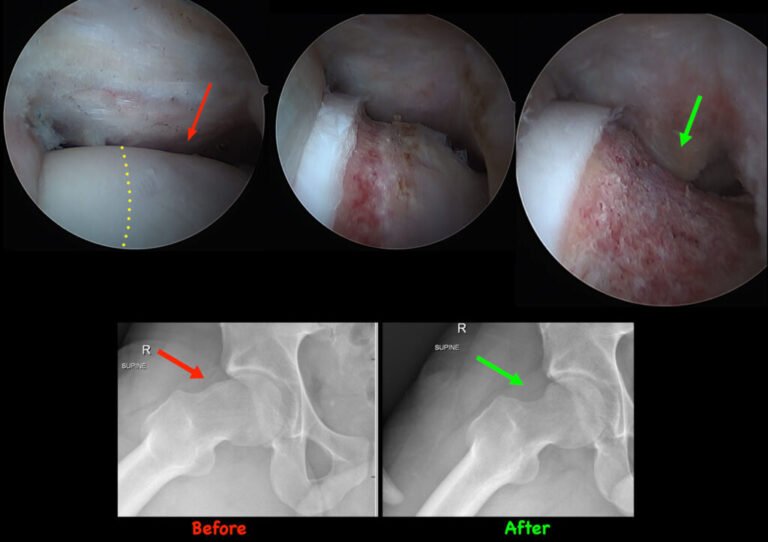
    • trimming excess bone in FAI
    • removal of loose bodies
    • treatment of cartilage damage
    • synovectomy or soft tissue work when indicated

    AAOS describes common arthroscopic treatments including smoothing torn cartilage, repairing or reconstructing the labrum, trimming bone spurs caused by FAI, and removing inflamed synovial tissue.[1]

    Why exact diagnosis matters

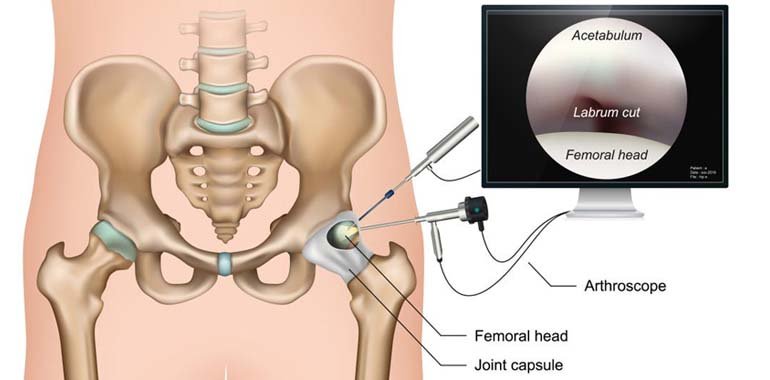
    Hip arthroscopy is not a single operation. It is a method of access plus a set of possible treatments. A patient with cam impingement and labral tear is different from a patient with snapping hip or loose bodies. That is why surgical planning must be individualized.

    Recovery After Hip Arthroscopy

    Many patients ask whether recovery is quick. The honest answer is that recovery is often easier than open surgery, but it still takes time and discipline.

    Early recovery

    After surgery, many patients need crutches for a period of time. MedlinePlus notes that crutch use may continue for two to six weeks depending on the procedure, and AAOS also explains that weight-bearing restrictions depend on how much work was done inside the joint.[1][2]

    During the early period, the goals are:

    • pain and swelling control
    • wound care
    • protected movement
    • avoiding limping
    • preventing stiffness

    Rehabilitation phase

    Physical therapy is very important. AAOS emphasizes that structured rehabilitation is usually necessary to restore strength and mobility after hip arthroscopy.[1]

    For patients in Bangladesh, I also discuss practical household issues:

    • staircase use at home
    • floor sitting or cross-legged sitting
    • toilet setup
    • transport for follow-up visits
    • support from family members in the early phase

    These details influence recovery more than many people realize.

    Expected Benefits and Realistic Limits

    In properly selected patients, hip arthroscopy can reduce pain, improve movement, and help return to activity. Reviews of arthroscopy for femoroacetabular impingement report generally favorable outcomes in selected patients, especially when the diagnosis is correct and the joint does not already have advanced degeneration.[4][5]

    Factors linked to better results

    A systematic review of predictors after hip arthroscopy for FAI found that younger age, lower arthritis burden, lower body mass index, and appropriate preoperative joint condition were associated with better outcomes, while more advanced degenerative change predicted worse results.[5]

    This matches what we see clinically. The earlier a correctable mechanical problem is treated, the better the chance of a strong result. If the joint is already badly worn, the benefit of arthroscopy becomes less predictable.

    What surgery cannot promise

    I do not tell patients that arthroscopy is a guaranteed cure. Some patients still have ongoing symptoms. Some need a long rehabilitation period. Some later progress to more advanced arthritis. In other words, arthroscopy can be very useful, but it is not magic.

    Risks and Complications

    Every surgery carries risk, even when complications are uncommon.

    AAOS and MedlinePlus both note risks such as:

    • infection
    • bleeding
    • blood clots
    • damage to nerves or blood vessels
    • stiffness
    • persistent pain
    • temporary numbness or tingling, especially related to traction during surgery[1][2]

    AAOS also notes that traction used during the operation can temporarily stretch nerves and cause groin numbness, though this usually improves.[1]

    For Bangladeshi patients, it is important to optimize modifiable risks before surgery:

    • diabetes control
    • smoking cessation if applicable
    • anemia correction when needed
    • infection screening
    • realistic rehabilitation planning

    Hip Arthroscopy vs Hip Replacement

    Some patients hear the word “hip surgery” and immediately worry about joint replacement. These are very different procedures.

    Hip arthroscopy is usually considered when:

    • the hip joint is structurally preserved enough
    • symptoms come from labral tear, FAI, loose bodies, or selected intra-articular pathology
    • the aim is hip preservation and symptom relief

    Hip replacement is usually considered when:

    • arthritis is advanced
    • cartilage loss is more widespread
    • pain is severe and function is significantly reduced
    • preservation procedures are no longer likely to help

    This distinction matters because the wrong procedure for the wrong stage of disease creates disappointment. If the goal is to preserve the native hip, arthroscopy may help selected patients. If the joint is already badly damaged, replacement may become the more rational option.

    When to Seek Orthopedic Evaluation in Dhaka

    You should consider orthopedic assessment if you have:

    • groin-centered hip pain lasting weeks or months
    • pain with sitting, squatting, or twisting
    • clicking, catching, or locking in the hip
    • stiffness that limits normal daily movement
    • sports-related hip pain that keeps returning
    • hip pain that does not improve with medicines and physiotherapy

    Urgent evaluation is important after major trauma, sudden inability to bear weight, fever with severe hip pain, or rapidly worsening symptoms.

    My Practical Advice for Bangladeshi Patients

    In my practice, I often see patients with hip pain move between general pain treatment, unstructured exercises, and repeated medication use without first establishing the diagnosis. That delays proper care.

    If your symptoms suggest a joint problem, I recommend focusing on three questions:

    1. Is the pain truly coming from inside the hip joint?

    Not all hip-area pain is intra-articular. The pain may come from the spine, muscles, tendons, or bursa.

    2. Is the hip joint still in a preservation stage?

    If the joint still has a preservation window, arthroscopy may be relevant. If the joint is already badly arthritic, expectations need to change.

    3. Are you ready for rehabilitation?

    Good surgery without good rehabilitation gives incomplete results. Recovery discipline matters.

    Hip arthroscopy surgery can be an excellent procedure in selected patients, but the success of the operation begins with accurate diagnosis, careful surgical indication, and a realistic recovery plan.

    References

    1. American Academy of Orthopaedic Surgeons. Hip Arthroscopy. OrthoInfo. https://orthoinfo.aaos.org/en/treatment/hip-arthroscopy
    2. MedlinePlus. Hip arthroscopy. https://medlineplus.gov/ency/article/007500.htm
    3. American Academy of Orthopaedic Surgeons. Femoroacetabular Impingement. OrthoInfo. https://orthoinfo.aaos.org/en/diseases–conditions/femoroacetabular-impingement/
    4. Grzybowski JS, Malloy P, Stegemann C, Bush-Joseph C, Nho SJ, Harris JD. Hip Arthroscopy for Femoroacetabular Impingement-Associated Labral Tears: Current Status and Future Prospects. Orthop Res Rev. PubMed: https://pubmed.ncbi.nlm.nih.gov/35480069/
    5. Kunze KN, Beck EC, Nwachukwu BU, et al. Predictors of Outcomes After Hip Arthroscopic Surgery for Femoroacetabular Impingement: A Systematic Review. PubMed: https://pubmed.ncbi.nlm.nih.gov/31259183/
    6. O’Connor M, Minkara AA, Westermann RW, Rosneck J, Lynch TS. Systematic Review and Meta-analysis of Outcomes After Hip Arthroscopy in Femoroacetabular Impingement. PubMed search record: https://pubmed.ncbi.nlm.nih.gov/?term=29373805

    Related Topics

    FAQs BY PATIENTS

    Hip arthroscopy is used to diagnose and treat selected problems inside the hip joint, such as femoroacetabular impingement, labral tears, loose bodies, and some cartilage or synovial problems when non-surgical treatment has not been enough.

    No. Many causes of hip pain do not need arthroscopy. The surgery is most useful when the pain is coming from a treatable intra-articular problem and the joint does not already have advanced arthritis.

    Recovery varies depending on what was treated. Many patients need crutches for a period of time and structured physiotherapy. Early recovery may take weeks, while fuller functional recovery can take longer depending on the pathology and procedure.

    In selected patients, especially when a mechanical problem like FAI is treated before advanced arthritis develops, arthroscopy may help preserve the native hip. But it does not prevent replacement in every case.

    Yes, it can be relevant for Bangladeshi patients with sports-related hip problems, especially when there is labral injury, impingement, or persistent joint symptoms after appropriate conservative treatment.

      Click to Chat
      Click to Chat
      Scroll to Top